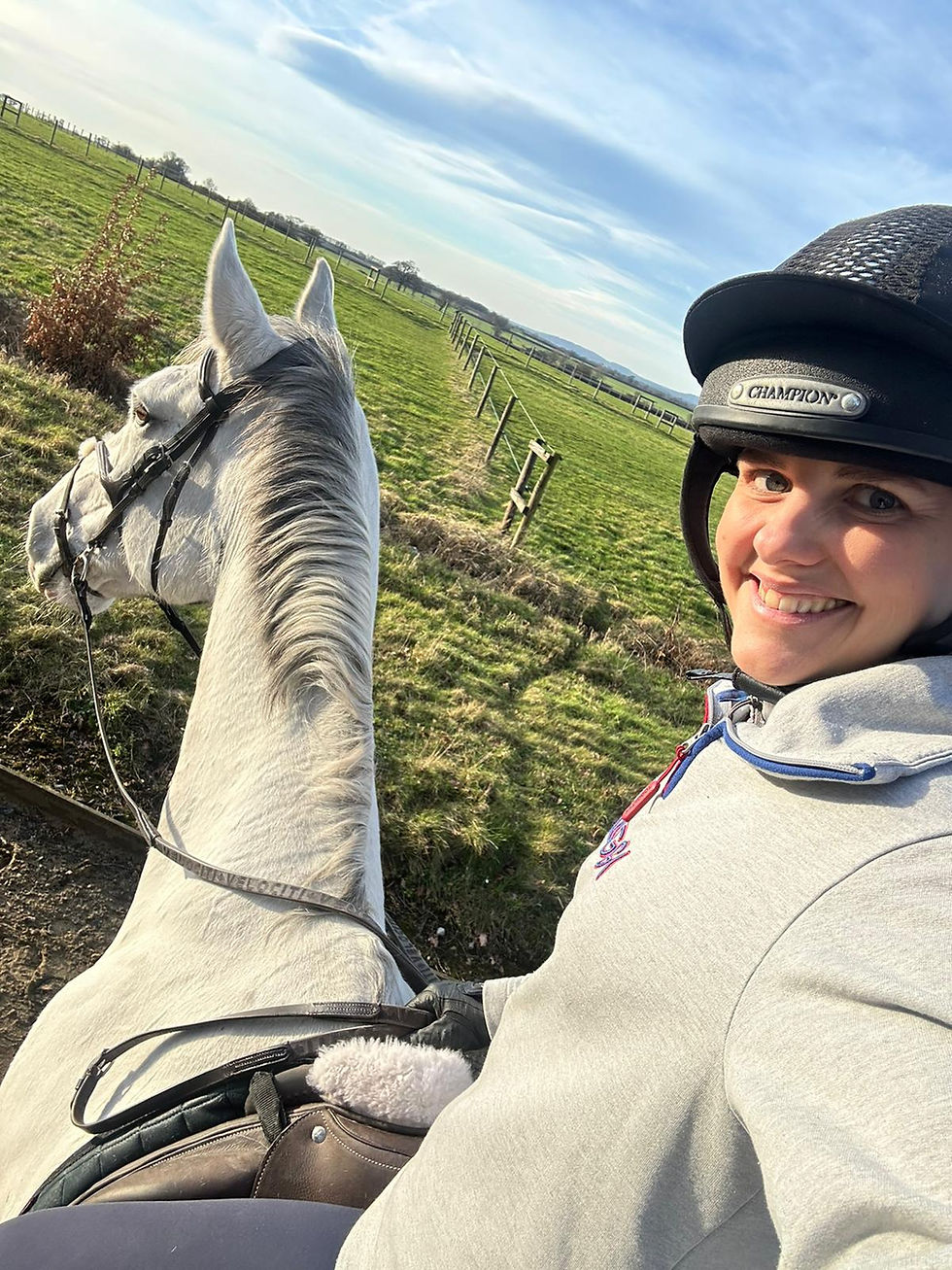
Why we yawn when we're stressed — and why it's a good sign in the saddle
Have you noticed you're suddenly yawning a lot?
Not the odd one here & there — I mean properly, repeatedly, at times that don't quite add up. Mid-ride. In the lorry on the way to a lesson. Standing at the mounting block before you get on. And you think, "why am I so tired?" — except you're not especially tired at all.
Here's the thing most people don't know: yawning isn't really about being tired. It's often a sign of stress.
When you're feeling stressed or anxious, yawning tends to increase. So if you've noticed yourself doing it more lately — around your riding in particular — it might be worth reading that not as "I'm exhausted" but as "there's a bit more going on under the surface than I'd realised".

So what's it actually doing?
Researchers who study yawning think it helps the brain & nervous system shift gears — moving you from one state into another. And it often turns up around stress & transition: people yawn before exams, before they go on stage, before they compete. It's not a sign nothing's happening. It tends to show up precisely when a lot is.
There's even early research pointing this way. A 2012 study by Dr Simon Thompson at Bournemouth University — what's become known as the Thompson Cortisol Hypothesis — found that levels of cortisol, the body's main stress hormone, went up when people yawned. It was a small study, & the researchers were careful to call it preliminary, so it's one thread rather than the final word — but it's a genuine hint that yawning & our stress response are more connected than we tend to assume.
I'll be honest with you — I know this one from the inside. A few years ago I went through a really difficult, stressful stretch tied to work. It was actually the thing that first sent me looking into my own mental health, & set me off down the path that eventually led me to hypnotherapy in the first place. And one of the things I noticed, without understanding why at the time, was that I was yawning constantly. A psychotherapist I was seeing back then said something that's stuck with me ever since: yawning is the body releasing stress. It completely changed how I saw it.
So when it arrives mid-ride, or the moment your feet hit the ground afterwards, it's less "I'm bored" & far more "my system is having a reset".
Your body has been holding more than you realised
Think about what's actually going on when you ride, especially if you're a rider who gets a bit nervous.
You've arrived carrying the day. Somewhere in the back of your mind you're braced — for the spook, for the strong canter, for the bit that usually catches you out. Your shoulders have crept up. Your breathing has gone shallow without you noticing. You are, quietly, holding a lot.
A yawn is one of the ways the body starts to let some of that go. A little release valve. Which is why it so often lands at the end of a ride, or in a moment where you've just managed something that felt big — your system saying, right, we can come down off that now.
Far from a sign something's wrong, it's usually a sign something's going right.
What to do with it
First, the easy part: let the yawns happen. Don't stifle them, don't apologise for them, don't clamp your jaw shut & fight them back. If your body is reaching for a reset, let it have one — suppressing it just holds the tension in. And honestly, let it be a little nudge of information too: if you've just yawned, the chances are your shoulders need dropping.
Second, you can give your nervous system a hand to settle — & one of my favourites for exactly this is box breathing. It's simple, & you can do it anywhere: in the lorry, at the mounting block, or sitting quietly on board before you walk off.
Picture drawing a square. Breathe in for four….. hold for four….. out for four….. hold for four. Then round again — in for four, hold, out for four, hold.
Three or four rounds is plenty. What you're doing is sending your body a clear signal that it's safe to come down a gear — & your horse tends to feel that settle in you too.
So: let the yawn come, drop your shoulders, & give it a few rounds of box breathing.
You're working with your nervous system rather than against it.
The bigger picture
This is a small example of something I talk about with riders all the time: so much of what goes on in the saddle starts in the body & the mind long before it reaches the horse. The tension you carry, the thoughts running before you've even tacked up — your horse reads all of it, & reacts to it.
Learning to notice those signals, & to work with them instead of being ambushed by them, is a big part of what I do with riders. The yawn is just one of the friendlier ones to spot.
So — next time that great big yawn turns up mid-ride, you can stop feeling faintly embarrassed about it. Your body's doing exactly what it's meant to.
If the thinking side of your riding is something you'd like a hand with, that's what I'm here for — have a look around the site, or drop me a message. X